By Noah Berkson
Serial Entrepreneur & Fintech Investor
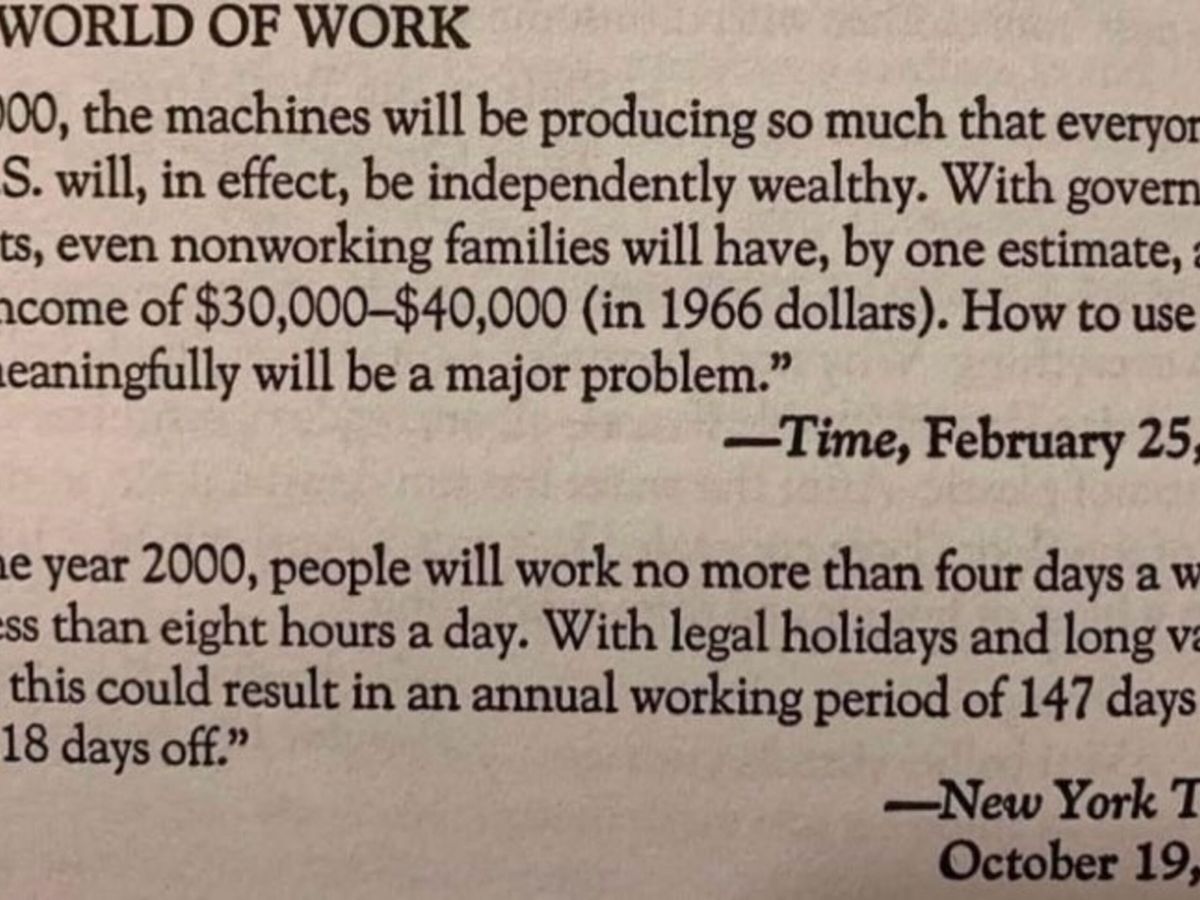
In the 1960s, TIME and The New York Times predicted that by the year 2000, machines would make us independently wealthy, working 4-day weeks with 218 days…
In the 1960s, TIME magazine and The New York Times predicted that by the year 2000, machines would make us independently wealthy. We'd work 4-day weeks with 218 days off a year. Technology would solve the productivity problem, and the abundance would flow to everyone.
They were right about the technology. They were completely wrong about what we'd do with it.
What the Prediction Got Wrong
The machines came. Productivity increased dramatically. The gains were real.
But instead of fewer hours, we raised our expectations. Instead of distributing the abundance, we concentrated it. Instead of a leisure crisis, we got a burnout epidemic. The technology did exactly what they predicted. The humans around it behaved exactly as humans always behave.
We used the productivity gains to do more, not to rest more. We used the communication tools to be reachable everywhere, not to disconnect. We used the information access to make faster decisions, then made more decisions to fill the time we saved.
The predictions failed not because the technology failed. They failed because they modeled technology without modeling human nature.
What Today's AI Predictions Are Getting Wrong
Right now, the prediction cycle is running again. AI will eliminate 40% of jobs. AI will create unlimited wealth. AI will make expertise irrelevant. AI will solve climate change, cure cancer, and end poverty within a decade.
Some of these will be right about the technology. Most will be wrong about the human systems around it.
Here's my read. AI will automate a significant number of tasks, but humans will fill the reclaimed time with new tasks rather than with rest. The people who understand AI will use it to outperform their peers, and the gap between them will widen. Organizations will adopt AI unevenly, with the fastest movers capturing most of the value.
The technology will do what it's designed to do. The question is always: what do the humans around it decide to do next?
How to Think About This Practically
If the 1960s lesson holds, the smart move isn't to predict what AI does to your industry. It's to position yourself on the right side of the productivity gap before it opens all the way.
The people who adopted email in 1993 had a decade-long advantage over people who held on to fax machines. The people who mastered search in 2001 built businesses that their competitors couldn't understand until it was too late. The pattern repeats.
The question isn't whether AI changes your field. It will. The question is whether you're the one using it to go faster, or the one wondering why everyone else seems to be moving at a different speed.
I think about this every week. Not because I have a prediction about where AI lands in 10 years. I don't, and I'm skeptical of anyone who claims to. But I know that the people who engage with it now, who learn its limits and its possibilities through direct use, will have a real advantage over the people who are still reading articles about it in 2027.
The bottom line? The machines are coming, and the predictions will be half right. The technology will do remarkable things. Whether it makes your life better or harder depends almost entirely on what you decide to do with it.
Start doing something with it. Today.
You can already see this tension in the AI talent race, like Workday's CTO leaving a public company to become an engineer at Anthropic.