
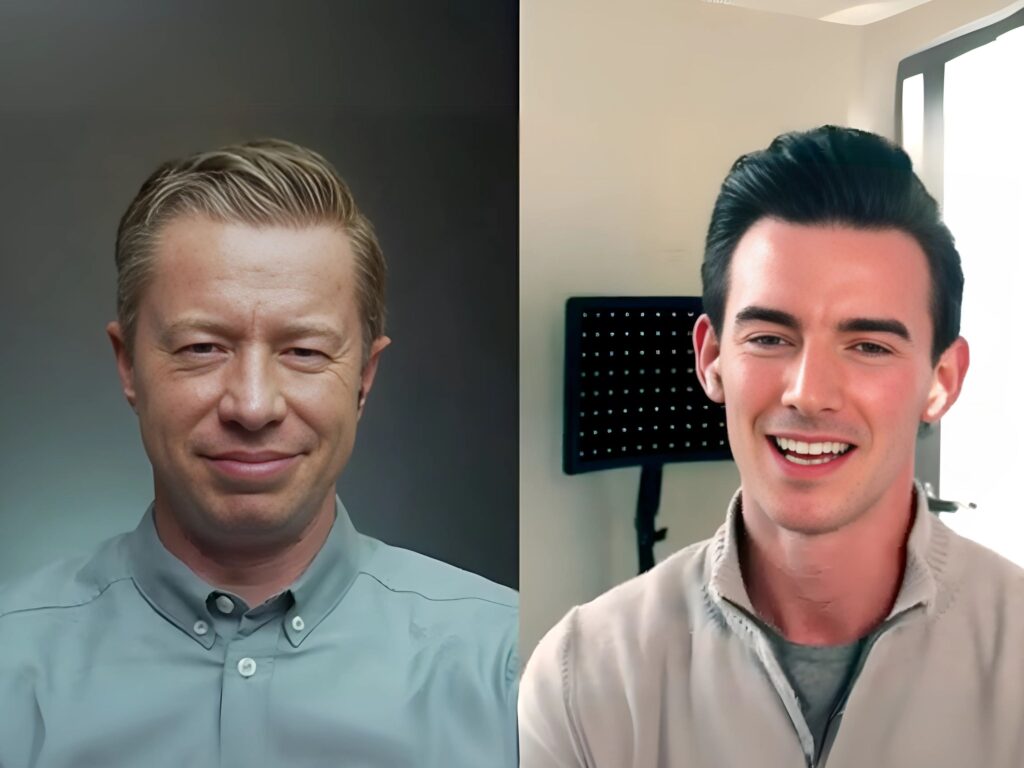
In a wide-ranging conversation on Jess Larsen’s Innovation & Leadership podcast, I shared my journey from knocking on doors in Iowa to building, buying, and incubating companies under the Austin Capital Partners family-office umbrella.
At 31, I’ve been fortunate to achieve several eight-figure exits, build a diverse portfolio spanning fintech and financial services, and develop a reputation as a connector.
My story weaves together gritty sales experience, strategic fundraising decisions, and an almost obsessive commitment to relationship-building—all framed by my mantra of being “long-term greedy.”
As Managing Partner of Austin Capital Partners, I’ve learned some hard lessons about the realities of building companies worth millions and discovered counterintuitive approaches that have fueled my success.
Table of Contents
Video
Watch the podcast on YouTube here.
Or watch it below:
10 Key Takeaways
Here are some key takeaways from my discussion with Jess Larsen.
Rejection Is Your MBA
Door-to-door security sales in Cedar Rapids, Iowa, became my entrepreneurial foundation. “You just get rejected all day for a living. You start to really embrace rejection and start to really like it, and it’s like a game. How do I overcome this?” This resilience transformed rejection from a barrier into a competitive advantage throughout my career.
Serial, Sector-Hopping Works
I’ve launched or scaled businesses in LinkedIn-style networking software, health-tech (340B compliance), drone-based property analytics, near-shore engineering staffing, and a Zillow-for-farmland marketplace called Common Ground. My success across disparate industries demonstrates that transferable execution skills often beat deep single-sector expertise.
“Unsexy” Businesses Can Create Massive Value
My near-shore engineering firm focused on Latin and South America grew fastest and produced an eight-figure exit—proof that “unsexy” labor-arbitrage models can mint cash, especially during the zero-interest-rate period of 2019-2021. “We’re staffing these people. Right. It’s a labor arbitrage. And they’re really good cash businesses. They can be tremendous cash businesses.”
Prep for Diligence Before You Need It
I learned the hard way that exit preparation should begin on day one. “You start out with this idea of building a business… But you don’t do any of the things that you would need to do to sell that business.” When buyers request 120 diligence items, sloppy contracts and missing records invite “deal fatigue” that private equity firms tactically exploit: “I think now understanding from the private equity side how you think about that… that’s all kind of part of the playbook.”
Avoid Arbitrary Fund-Raise Targets
A common mistake I see is entrepreneurs raising capital without strategic milestones: “They say, ‘Hey, I need to go raise this much money’ without really realizing: is that amount of money going to get you to where you can raise more money?” Many startups raise $3M because “that’s what people do,” only to burn it in 12 months without achievements that support the next round.
Bootstrapping Buys Optionality
Owning 100% of a $30-100M outcome can beat swinging for a billion with VC strings attached. “When you bootstrap, your options are great. Generally, if you have a good business, you can find a buyer who’s excited.” In contrast, venture-backed founders face a binary outcome: “Are you joking? We signed up for this to be a one or a zero—it’s either a billion-dollar business or it’s nothing.” This creates “founders who are entirely unmotivated and completely burnt out, but forced to drive toward an outcome that candidly probably won’t happen.”
View Investors as Partners, Not ATMs
I emphasize building authentic investor relationships through transparency: “I think being able to tell a story and being realistic is important… Here are all the challenges in this business, here are all the headwinds we’re facing.” This approach cultivates allies who step up during crises—as when one investor wired an eight-figure rescue check overnight during a business emergency.
Lead With Value in Networking
With ultra-high-net-worth individuals and family offices, my rule is simple: “I want to add value right away… I want to have my relationship bank account and I want to be the person that’s like, I can provide you so much value. I’m not going to ask for anything.” My primary currency is connections across diverse industries: “Oh, someone has a random… What are you working on? Oh, we have this nonprofit where we’re funding, like, bees. Oh my God. Actually, I know the perfect person you’ve got to talk to.”
Momentum + Systems = Relationship Capital
I believe initial interactions must build immediate momentum: “You and I hop on a call and we have a good conversation, and then I can either say, ‘Yeah, cool. Let’s chat sometime, keep in touch.’ And that relationship is probably never going to be close.” Instead, I make immediate plans or introductions while maintaining a sophisticated system to track follow-ups.
Be “Long-Term Greedy”
Quick money quests often backfire. “When you’re like, how do I make money as quickly as possible? That doesn’t go well. But really looking at things in a much longer time horizon.” This patient approach guides calmer decisions and prevents the FOMO that drives poor choices: “When you’re younger… you go, well, you have all these things like, why don’t I have that?… I think that can make you make very short-term decisions that aren’t going to be very optimal for the long term.”
Beyond LinkedIn Connections: Redefining Network Value
I’ve come to believe that “your network is valued not by the number of people in it, but by the number of people that know each other because of you, that wouldn’t have met otherwise.”
This perspective has shaped how I approach both my podcast and conference initiatives.
For my upcoming Park City conference and new “Dose of Greatness” podcast with Jeff Ma, I wanted to create spaces for authentic connection.
I saw a gap in the market between typical business conferences with “great people you might want to do business with” but stale content, and more experiential events where “the people are often a little bit too woo-woo.”
The goal is to bring together “really incredible people where you’re also able to have fun together” because “the bonding comes from doing things that are fun, not from sitting there listening to a speaker.”
Similarly, with the podcast, I want to move beyond success stories to explore the human dimension: “There’s a lot of podcasts out there that we like, but a lot of it, there’s not a whole lot of vulnerability.”
The format aims to ask the questions that rarely get addressed: “You’ve made all this money, but are you actually happy?”
I explore the different mindsets required for building versus investing in Investor vs. Founder.
Conclusion
My career is less a straight line and more a series of compounding relationship loops: each venture, exit, or introduction layers onto the next.
From door-to-door sales rejection to eight-figure exits and building a sophisticated family office platform, my journey demonstrates the power of embracing challenges, building genuine relationships, and maintaining a long-term perspective.
As business environments become increasingly transactional, I’ve found success through emphasizing authentic connection and strategic patience.
For entrepreneurs navigating their own journeys, I believe sustainable success comes not just from raising capital or achieving exits, but from creating a web of meaningful relationships that provide both personal fulfillment and business advantage.
If you borrow nothing else from my playbook, remember this dual approach: master rejection early, then play the longest game in the room.
Being “long-term greedy” isn’t about delayed gratification—it’s about building something that creates enduring value for everyone in your network.
Transcript
Here is the transcript:
Jess Larsen: Welcome to Innovation and Leadership. I’m Jess Larsen. On this episode, we get to have Noah Berkson. We’re going to hear about his big exits as an entrepreneur, working with funds, the family office, the Weekend of Man, his new podcast, and a lot of fun things. Noah, thanks for doing this. And how do you introduce yourself when people ask what you do?
Noah Berkson: Thank you so much for having me, Jess. You know, it’s funny because that’s always like the scariest question when you have a lot of things that you’re doing and there’s not a super cohesive answer, but just from a high level, I run a family office platform day to day. We’re called Austin Capital. We’re a kind of vertically integrated fintech financial service platform spun out of a family office, a single family office. So we own a bunch of assets in the space, one being a trust bank in Nevada. We have a modern core banking business. So banks and FIs run on our core. We have a payments issuer processor. We have a high-risk payments business. We have a few RIAs, an asset management platform, a professional services business, virtually anything that touches fintech financial services. And we both invest, we incubate, we buy, and we’re really excited about that. Outside of it, I run a farmland marketplace. Think of us kind of like Zillow for farmland called Common Ground that we incubated out of our fund in 2020.
Jess Larsen: Very cool. Let’s do a little bit of backstory. Tell us, tell us a couple of the big career highlights pre-family office work here.
Noah Berkson: Yeah. So I grew up in the Midwest, grew up in Iowa. I was a terrible student, just awful. Had really bad ADHD. But I think I got my first kind of opportunity doing door-to-door sales and kind of learned entrepreneurship in some regard from that. I started out in Cedar Rapids, Iowa, selling home security systems door to door. So you just get rejected all day for a living. You start to really embrace rejection and start to really like it, and it’s like a game. How do I overcome this? I took that experience and ended up going to college, the University of Iowa. I ended up starting a company. Then originally, the idea was to create something called Grid. The idea was kind of like LinkedIn right when LinkedIn was up and coming but still in the pretty early days. And that ended up turning into a software development business. I brought that to Chicago, ended up exiting out of that, and was kind of looking for the next thing. I joined a couple of guys building a health tech business. So we built a SaaS platform for hospitals and health systems to assist with this pharmaceutical drug discount program called 340B. You know, funny enough, it’s been my longest-standing investment and I got some really good news this past Monday about that business. So I’m really excited about that. Then I went and did a joint venture, building a property analytics company. So we used drones to survey pavements and roofs of large industrial property owners, retailers, and REITs. Think of like Walmart and Blackstone and Prologis of the world. We would do these property surveys to help them understand how to do capital and maintenance expenditures. So a very kind of boring business. But bringing a tech approach that made a whole lot of sense. When I got out of that, I ended up starting a staffing business kind of by mistake. I was doing a bunch of angel investing, realized that a lot of the companies I was investing in were saying, “Hey, Noah, can you help us build some offshore engineering teams? I know that you’ve done that in the past. We want to keep our burn down.” And so I was helping with that, and you know, at that point, I said, “Well, wait, I should be making some money doing this. Like I’m doing a lot of work for free.” And I ended up starting a staffing business with a friend of mine. We were lucky enough to scale that. We hit really good timing as well. Think like that 2019-2021 period. We ended up selling that at the end of 2021. Alongside it, we’d spun up a venture fund that was called Candor Ventures. Kind of the insight there was, hey, we’re staffing a bunch of these companies that are really early stage, and we have a pretty unique insight into what’s happening in them because, as most investors sit, they have whatever information the company’s telling you, right? So it’s like, “Everything’s going great. We’re on the upswing. Prospective customers love this.” And we’re in there because we have all these engineers, and they’re like, “Well, the sales demos aren’t working” or “The product isn’t working” or “They’re having these issues.” So we’re like, ah, we kind of have a unique insight here. Why don’t we spin up a fund and just start investing in some of these companies? And so we started something called Candor Ventures, and ended up creating a studio arm of that as well, with the idea to incubate businesses, one of which was that Farmland Marketplace that I mentioned called Common Ground.
Jess Larsen: Yeah, so you’ve told me some pretty impressive numbers before. Are you sharing any of the size of any of these exits publicly?
Noah Berkson: Nothing is public right now. But, you know, we’re really happy about it. I think we rolled part of the deal of our studio and then also of our staffing business into a kind of a Holdco platform, which, when you do that, you’re definitely taking a gamble. I think that will pay off really tremendously for us. So I’m really excited about that. But it also is time, and it’s also putting your time and attention into something for a long period.
Jess Larsen: Yeah. Are we allowed to at least say how many figures without saying the number, or do you want to…
Noah Berkson: Hold on. Yeah. Eight figures.
Jess Larsen: Yeah. So when you think about a business with that many zeros, what did you not expect from all the books and all the YouTube and all the everything everybody tells you? What did you not expect until you actually did it yourself?
Noah Berkson: I think what you don’t expect is, you know, it’s funny, you start out with this idea of building a business. In this case, we really didn’t anticipate selling it, but generally you think, oh, one day I could sell this business. But you don’t do any of the things that you would need to do to sell that business. So when you get to that point and you start in diligence and whatnot, you go, then they’re just dumping like, “Hey, here’s a list of 120 things that we need you to give us.” And you start looking and go, “Well, oh man, we haven’t.” Like, we signed a contract one time with that client three years ago. We never updated our contract. Oh, well, that’s not really… They’re like, “Well, is that a valid contract?” Like, we don’t know. You just don’t set anything up to actually exit out at the end. And so everything is such a mess in the business, and it takes so much time to be able to get all of that together. I think what I see in a lot of other friends and entrepreneurs who have sold their business is because of this, they get into this… I mean, selling a company is generally a lot of work and takes a long time anyway. Always longer than you think it will. But there’s a lot of deal fatigue, and you kind of get to the point in that deal where you go, “I just want to get this deal done.” And I think now understanding from the private equity side, how you think about that as a private equity firm or investor, that’s all kind of part of the playbook. So it’s like we know that there’s going to be deal fatigue in this, and we almost want there to be because at the end when we come back and we say, “Hey, I know we agreed on this number, but we’re gonna only be able to get it done at somewhere below that.” And someone’s just gonna say, “Yeah, I just, you know, I’m mentally now invested in getting the deal done, and I’ve already in my mind like that deal is done, so now let’s just get it done.” And so I think, yeah, I think the deal fatigue and just being ready was something that I really didn’t expect.
Jess Larsen: Yeah. You know, when I was in M&A at Citi 20 years ago, we were doing sell-side transaction fees, and it’s like literally we had to teach CEOs. I’d be talking to somebody who’d owned the business for 30 years and had to talk about, like, “Hey, so let’s think about this as if you’ve never actually played basketball before—the game of selling companies.” And you know, we’re going to send this out to 1,500 private equity groups in a wash description trying to get 100 NDAs signed of people that say the real thing. Get down to six people, you know, six different firms. We want to get a bidding war for you. But here’s the thing. You know, these guys buy many companies per year. You’ve never sold a company in your history. And you start telling them these tricks, right? It was like, honestly, it’s like the car salesman where, you know, they have to keep going back and talking to the mysterious finance guy that you never get to meet. And it takes forever, and they’re giving you tons of drinks so that you need to use the restroom, and three and a half hours later you’re just signing something you wouldn’t have signed two and a half hours earlier, right?
Noah Berkson: Yeah, absolutely. And I think, you know, during the process too, because generally when the process sets out, it’s going to take a period of time to get the deal done. They’ll say, okay, great. And I see this a lot of times in startup or venture companies too. They’re like, “Well, where are you going to be? Let’s say, what are your projections for this year?” And you know, you start this negotiation in February and you’re like, “Oh, we’re going to do 10 million in revenue this year when we did 2 last year.” Right. And they go, “Okay, wow. Like, yeah, incredible.” But by the time that deal is getting done, it is the end of that year, and they’re like, “Well, you said you’re going to be at 10 million in revenue. Like, you’re at 3 million right now. Like, we’re going to have to go back and redo these terms.” So I think also just understanding that all of those things, they’re going to come back to that, and that is the basis that they’re looking at for the business. And so I think also being very realistic about where you’re going with the business.
Jess Larsen: Yeah. So I know we’re not disclosing numbers, but can you tell people which one of the businesses grew the biggest?
Noah Berkson: That you were running our staffing business? For sure. You know, I think having… So we did nearshore staffing; I guess a little bit was outside of that in Asia, but predominantly South America and Latin America. I think you saw, too, that during the ZIRP era, you’d have clients coming and they’d say, “Oh, we need 60 engineers, or we need 40 more engineers.” And you’re like, wow, we’re staffing these people. Right. It’s a labor arbitrage. And they’re really good cash businesses. They can be tremendous cash businesses. I would say now, as I look at it, the industry is becoming a lot more challenging. People are seeing that there’s an opportunity to enter; like, the barrier is fairly low. And so you’ve seen a number of companies start to enter the space. I think what I’m seeing today is companies that are trying to find their niche and say, “Okay, instead of general product, we’re only doing market engineers that work on marketing, or we’re only doing engineers that we staff to fintech companies.” And so you’re seeing people start to specialize a lot instead of being very general. And I’d expect that that’s where the industry will go, at least for the next three, four, five years.
Jess Larsen: Yeah, well, you know, a topic we bring up a lot on the show that’s always interesting to both CEOs and fund managers is fundraising. So thinking about both fundraising as an entrepreneur, fundraising as a fund manager, where you’ve got to get your LPs, and then also being the investor as you’ve had these other roles. Do you notice? Let’s start with what you see as a couple of rookie mistakes out there when people are trying to start raising in the many millions.
Noah Berkson: I think for entrepreneurs that are raising, there are often very arbitrary numbers that get put out. They say, “Hey, I need to go raise this much money” without really realizing: is that amount of money going to get you to where you can raise more money? We see, especially right now, a lot of companies get stuck where they say, “Hey, I’m going to raise $3 million for my pre-seed or seed round.” And that $3 million lasts a year. But a year in, you haven’t actually made that much progress as a business. Maybe you’ve built your first product, got a couple of customers, but that story is not compelling enough to go raise more money at a higher valuation. I see a lot of companies getting stuck right there. I also see a lot of companies that are raising way more money than they actually need. There are many situations now where I’ll talk to companies and they’re like, “Oh, we’re at $300,000 of ARR or $500,000, and now we need to go fundraise,” where they haven’t taken any capital yet. And I’m like, “Why are you doing that?” And they’re like, “Well, that’s just what you do, right? We want to build a team. We want to grow.” And I’m thinking, even though I’m an investor, I’d like to invest in that company from the other side, I would not want to take investor capital at this point. Your life is going to be so much easier because there are a lot of those businesses that can be phenomenal, but they might sell for $30 million, $50 million, $100 million, and own all of it. But the second you take on that investor money, you have to have a huge outcome and everything is driven towards that. Even with my own experience with our Farmland Marketplace, we raised venture capital. We originally didn’t plan on it. We said, “Hey, we’re just going to bootstrap this.” And then in 2020, we started just getting emails from people that were using it like, “Hey, are you raising money?” For a while we thought, “That’s nice. It’s flattering. It means we’re probably on the right track.” But eventually it was like, “No, we want to invest.” And then you go, “Well, if it’s going to be this easy to raise money, we may as well raise money.” But in retrospect, I think you make a lot of decisions when you have money very differently than you would when you didn’t have it. A good example in that business was we said, “Hey, we see Zillow makes a lot of their money from these broker tools or their housing professional tools. The agriculture marketplace is very similar, so why don’t we build some tools for land professionals?” Right away people were excited about it. They were like, “Yes, we can’t wait to use it.” And then we’d give it to them and they’d be like, “Oh, I’d love to use it, but it doesn’t have this one feature yet.” And then we’d think, “Well, we just need to build that next feature. We have the money to do it.” And you go down that path. After a while we realized, “Wait, this is not working. People do not actually want this in the way that we think they do.” Whereas if that was your own money, you would quickly say, “Oh, that’s not working. Let’s just pivot away from that entirely.” Compared to, “Let’s just keep trying and keep trying and keep trying.” That’s a hard lesson to learn.
Jess Larsen: Yeah. Why do you think that bootstrapping is so underrated?
Noah Berkson: Why do I think it’s underrated? I think people really just don’t understand the game as they get into it. Many people are good at one thing, so they start a company and they don’t really think about all the other levers in a company or truly understand where that company can go. There’s just this idea that, “Oh, this can be the biggest thing ever. Our addressable market is huge, so we’re going to capture that. Even if we get 1% of this market, we can be a huge company.” But a lot of people don’t understand that you will never have 1% of that market and how tremendously hard it is to achieve that. And that you also have optionality when you bootstrap. Yes, it is more challenging from the beginning. It does force you typically to get profitable very quickly. Where I see a lot of movement right now is people realizing, with Palantir being a great example, that services can be really lucrative businesses—services kind of as software. So when people bootstrap, they say, “Okay, we need to start with some type of services because we can get customers right away, they can pay us, and that can support the business.” But they think that in the long term that’s going to derail the value of the business. I think we’re finding that it’s quite the opposite today if you can be sticky. Burnout is another piece of this that people don’t think a lot about. When you do something every day and it’s a grind for three, four, five, eight, ten years—probably 12 years is the average that a company is going—you may get to a point where you say, “I don’t want to do this anymore. I’d love to sell the company.” If you bootstrap, your options to do that are great. Generally, if you have a good business, you can find a buyer who’s excited. But when you’re venture-backed, your investors are like, “Are you joking? We signed up for this to be a one or a zero—it’s either a billion-dollar business or it’s nothing.” So they say, “Absolutely not. Get back and keep going.” I think that’s the scariest thing. We have founders who are entirely unmotivated and completely burnt out, but forced to drive toward an outcome that, candidly, probably won’t happen. The investors say, “Well, it’s fine if it’s a zero,” but you’re going to spend your entire life trying to build that company, put everything you have into it, and it may ultimately be a zero.
Jess Larsen: Yeah. I think about a couple of bootstrapping stories out by me. You know, Pluralsight bootstrapped for, I don’t know, like 10 years and then took some money, got into the billions. You know, Qualtrics, same thing; I think they bootstrapped for like 9 years or 12 years or something, and then, you know, reached the tens of billions. Right. And I’ve been at conferences, or, you know, I’ve met both Aaron Skonnard and Ryan Smith, and they talk about things like the discipline of bootstrapping. Like, when you come with that mindset and you figure out your product-market fit, then you pour gas on the fire. Do you know why they feel like that model can be so superior sometimes?
Noah Berkson: Yeah, absolutely. I mean, there are so many great examples of people who have bootstrapped, but also people see the now, right? Like, wow, that company’s so successful. They don’t realize they’ve spent the last 12 years of their life, you know, every day, every day on this business to get it where it is. Backbase was another really good example in the financial services space. That was like a two and a half billion dollar business today that was bootstrapped. But, yeah, I think it’s tremendously underrated. I do think, though, that with the growing proliferation of AI, you’re going to see a lot more companies that have the ability to bootstrap and say, well, I don’t really need to spend 500,000 or a million dollars to build this product. I can get 80% of the way there with, I don’t know, a couple thousand bucks building something, and we can get some revenue and then keep driving. So I hope to see that.
Jess Larsen: Yeah. What’s one thing that you feel like you did right with fundraising?
Noah Berkson: I think being able to tell a story and being realistic is important. I want to set expectations when we’re fundraising. The natural inclination is to say, “Hey, this is going to be the biggest business ever. This is going to be the next Uber, Airbnb, etc.” But I think being able to be realistic and say, “Here are all the challenges in this business; here are all the headwinds we’re facing. If we’re not successful, here’s why we won’t be successful,” helps set expectations from the start. Otherwise, you have investors saying, “You said it was going to be this, and that’s not where you are.” Along the way, you want your investors on your team. That’s really important. Some people look at investors and think, “I just get a check from them,” making it very transactional. But those will be the most important people, especially through hard times. I have friends who had a business issue where they lost a bunch of money—not their fault—and one of their investors stepped in within hours and said, “I’m wiring this over to you”—an eight-figure check—“I’m wiring this over right now; we’ll figure this out later. I want to make sure you guys are okay.” When you tell that investor something that doesn’t materialize, you don’t get that type of goodwill.
Jess Larsen: Yeah. When you think about starting relationships—let’s say with family offices, ultra-high-net-worth individuals, maybe more so than institutional investors—when you think about a less transactional beginning of a true relationship, what’s a principle or something that you feel is effective?
Noah Berkson: I feel like for me it’s always about adding value. I want to add value right away. I think that I want to take as long as possible. You know, when you think about relationships, it’s kind of like long-term investing. This stuff just compounds. I want to have my relationship bank account, and I want to be the person that’s like, “I can provide you so much value. I’m not going to ask for anything.” Because I think then it’s just like you start these transactional relationships, and even if that works right away, in the long term, I feel like those aren’t the relationships that I want to have. So I say, how do I give you some type of value right now? And with ultra-high net worth people, really successful people, family offices, many times that’s challenging for people because they go, “Well, they’re the ones that have all the money, they’ve been successful. How am I valuable to that person?” I’ve found generally it’s through relationships. I spend so much time cultivating relationships across industries. So not just one industry—like, my day-to-day is financial services. If I only knew financial services people, that wouldn’t be very helpful for me. But typically it’s like, “Oh, someone has a random… What are you working on? Oh, we have this random project. We have this nonprofit where we’re funding, like, bees, right?” “Oh my God. Actually, I know the perfect person you’ve got to talk to. They’re really interested in this.” That could be a great connection. Or how do you just find enough people around you that you’re able to connect? I think that’s the easiest way to add value right off the bat. And I also think it’s the way for people that might say, “Well, from a business standpoint, you haven’t been as successful as me, right? So I don’t look at you as a peer, right on my level.” But then I introduce somebody else that’s right on their level, and they go, “Wow.” The second I send an intro, that person responds, and they’re like, “Oh, who is Noah? Clearly he knows the right people.”
Jess Larsen: Yeah, I like that. On your Twitter, it says Chief Networking Officer. Um, so I think that’s a… I think.
Noah Berkson: But sorry to cut you off. I think that’s a big opportunity, by the way. Just if you let me rant. So I think there’s a lot of… A lot of the most successful people that I know, at a point, they become more insular. So they go from kind of being like, “we need to meet everyone, we need to network,” and then they get successful and they’re like, “I don’t really need to do that. I kind of keep my circle close.” And, you know, I don’t make many new friends. Like, people I actually like, I get on calls sometimes, but it’s not like people I actually hang out with. And I think there’s a big opportunity to kind of be like this Chief Networking Officer for people. You say, “I’m going to enter, you’re going to pay me, but it’s a service.” Right. But I’m going to introduce you to a bunch of other stellar people that you would really get along with, and you’ll probably be lifelong friends with them. And so whether that’s like, “hey, I’m traveling here.” “Oh, great. Let me introduce you to this person. You guys got to get together.” I think there’s a lot of that because I think the older you get, you just stop doing all the things. A friend of mine, we go visit in Vermont every year. He’s like in his mid-70s. His name’s Kevin, and he goes out, like, mountain biking with us. Most active mid-70-year-old you’ve ever seen. But, you know, we were asking, “what’s a piece of advice that you have?” And he said, “always have younger friends.” I was like, “why?” He’s like, “well, because as you get older, people just stop doing things, right? All of your friends, they’re kind of busy with their family. They’re busy with what they’re doing. They stop going on the adventures. They stop taking the spontaneous trips. They stop doing the endurance events.” And he’s like, “but I want to do that. So I figured out my conduit to that is just to always make younger friends.” And I really resonated with that.
Jess Larsen: That’s awesome. Okay. Speaking of friends and networking, I figured you got to give a shout-out to our mutual friend AJ who got us together. To me, he’s an example. Like, he’s already introduced me to multiple interesting people. I know you guys hang out a lot together. What do you like about AJ?
Noah Berkson: I think AJ is one of the most dynamic people. His ability to span industries, right? Where he’s respected, not only in the industry that he works in, which was sports and is now in the AI interior design space. But people that you’d meet anywhere respect AJ and they go, “Oh, AJ!” They see him very highly. And I think that’s also because he’s a great connector. He goes out of his way to meet people with no intent, right? So he’s meeting people. He will go to events that have nothing to do with what he’s doing just because he’s like, “I’m gonna go meet people.” You know, it was so funny, actually. A friend of mine said they met AJ and I go, “Where did you meet him?” Because I was like, “Oh, interesting. Where did you guys cross paths?” And she goes, “Oh, it was a women founders event.” I go, “You met AJ at a women’s founders event?” And she’s like, “Yeah, he was like the only… there were two guys there, and he was one of them. And there were like 200 women.” Like, I love this. This is what I love about AJ. He makes his way and he goes to those things, and he seems to just, like in a crowd, find the right people and he builds relationships and he adds value. And he follows up.
Jess Larsen: Yeah, that follow-up is so key, isn’t it?
Noah Berkson: The follow-up is so key, and it’s absolutely the hardest thing. But I think, you know, for instance, for me, I’ve gotten better at it. I’m definitely not the best at it, but I keep a sophisticated system to be able to follow up with people and make sure that I’m keeping on top because it’s really easy. My thought on any new relationship is either you build momentum the second that you meet someone. So, like, you and I hop on a call and we have a good conversation, and then I can either say, “Yeah, cool. Let’s chat sometime, keep in touch.” And that relationship is probably never going to be close because I think you just have that moment of momentum. So it’s like, okay, today, who can I introduce you to that’s going to add some value to your life right now? Oh, let’s make some future plans. Hey, you have something going on. You’re in Park City. I’m going to be in Park City these dates; let’s see if we can get together. And so I think it’s so much about just building momentum right away in a relationship. Otherwise, that’s kind of the difference between having something that’s like, this is going to be a very close friend, or this will be kind of an acquaintance, and maybe we’ll cross paths in the future. But what was the point of us talking if there’s nothing there?
Jess Larsen: Yeah, no kidding. Are you 31? 32? How old are you?
Noah Berkson: 31.
Jess Larsen: When you think about how, like, the level of, you know, going from door-to-door sales and, you know, working, I think, in the restaurant industry before that to millions and millions of dollars at your age, there are so many entrepreneurs that want to do that, and there are so few that accomplish that, especially in that time period. What do you think is different about you? What do you think you’ve done that others haven’t done?
Noah Berkson: I got a really early start. So you think about college. Like, I spent most of that time kind of… I don’t know if acting like an adult. I was super immature, but, you know, kind of living the life of an adult. So, one, I got a really good head start. Two, I think just understanding the value, again, like, back to this, but understanding the value of relationships. And I think from a really early age when I moved to Chicago with my first business, I met a guy who became kind of like a mentor to me. He owned a bunch of restaurants and nightclubs in Chicago, which is the most, you know, random of things for the person that is like a mentor to you. But he just really taught me the power of relationships. And it was clear, like, he owned these things. Yes, there was money involved with it, but he realized the network that he built from it. And it was just an interesting way. Like, you wouldn’t really think of that. Like, “Oh, you own a restaurant because you own a restaurant. You own a nightclub because you own a nightclub.” He’s like, “Oh, but if you see all the people that come to get in here every night, like, I become very close with those people. Those people become my good friends. I have a lot of power in this dynamic. Even though those people may be much more powerful and successful and, you know, wealthier than I am, they really want to get a table on that Friday night, or they really want to get into that nightclub, right?” And so it was just interesting to observe that at a pretty young age. Because, you know, when I grew up in Iowa, I didn’t know what a mentor was, right? Like, I didn’t grow up around wealthy people. Didn’t really have any kind of inkling into that world. But I think going through a lot of rejection and learning to embrace it, that was a big, big learning for me. We went to our team for this door-to-door security sales. We became the top team in the country in Iowa. They would track this week, every week, and how many security systems you’re selling. And so, as a reward, we got to go to South Central Los Angeles for a summer. And basically, the way that the home security industry works is virtually they put people in these five-year contracts and they track this. So if a certain neighborhood has five-year contracts, all of those probably expire right around the same time because they all get sold right at the same time. And so they knew that these areas in South Central Los Angeles were about to expire. And it’s like an area that actually has tons of crime. There’s a reason you have a home security system living there. But we got to go there. And that was kind of like our present because it was, “Hey, you guys are the top performing team. We want to send you there because you’re going to close so many deals. Like, you can make so much money doing this.” And so, yeah, you know, it’s just funny reminiscing on this. We were maybe, I don’t know if it was nine or ten guys living in this like two or three bedroom apartment. If I remember, like, you’re just sleeping on the floor, you get up, you fit everyone into a tiny car, and they just drop you off in a neighborhood. They say, “Don’t take your cell phone, don’t take a wallet, maybe take like a few dollars to grab lunch, you know, at a gas station or whatever. We’ll meet you back here at 9 pm” and this could be like 8 am and you’re just out. You’re very out of place. Like, you feel a little bit on edge the whole time. But you get to this point where like, wow, I can really embrace this. And you’re just loving it and you’re loving being able to look at somebody’s house from the outside and say, “I know every reason you’re going to tell me why you don’t want to buy this. And it’s going to start with you telling me, ‘Get off my property.’ And it’s going to end with you shaking my hand, thanking me so much, you know, and maybe introducing me to your kids who are there.” And so I think just learning to embrace rejection was a really big thing for me as well.
Jess Larsen: Yeah, no kidding. Well, you know, when you talk about this networking and getting people together… I know your conference is coming up. Why don’t you talk about your podcast and your cool co-host?
Noah Berkson: Yeah, I just started a podcast. I will release it hopefully sometime in December. Maybe it’ll be early January, I think. I’ve learned very quickly in starting a podcast. You think it’s very easy, as I’m sure maybe when you started that you did, and then you realize, wow, there’s a lot that goes into this, like, oh my God. But I started with a friend of mine, another entrepreneur named Jeff Ma, who you’re going to speak with, I think, at the beginning of the year here. We came together and we were talking about a platform. We said, hey, like, there are a lot of podcasts out there that we like, but a lot of it, there’s not a whole lot of vulnerability. A lot of what you’re seeing is like, it’s “How I Built This,” which is fantastic. It’s kind of the story of how you started the business. It’s the, “hey, I’m really wealthy now,” but it’s not the, “I don’t know what’s really hard in your life, what’s super challenging.” Like, hey, you’ve made all this money, but are you actually happy? Because time and time again, I think you realize that the people that have done that, they’re just as unhappy as everybody else, maybe more unhappy. So we wanted to create a framework around that, to be able to interview really interesting people, but just understand, like, what are they going through, what is their life like? And the way that we preface it to guests is if somebody wanted to get to know you on a very personal level, you would send them our podcast as a way to do that. So we’re really hoping that can turn into something. I’ve spent a lot of fun doing it, and I just realized, like, I get so much energy from it. I mean, you have the best job in the world with this, being able to just interview a bunch of really interesting people and get to chat with them. And that’s—I mean, I don’t know what more you can ask for. One thing I will say that I think is funny—I had a podcast before that was in the venture capital space, but when I was getting into venture, I was like, I need to meet investors. But most investors don’t really care to meet you. It’s not like the top priority of somebody when you’re like, “hey, I’m just getting into the space and investing.” They’re like, “great. Are you raising money for a company?” “No.” “Like, I’m really busy. Are you going to invest in our fund?” “No.” “Okay, great. I’m really busy.” I was like, that’s kind of challenging. So I said, well, actually, I have an idea. One day I just wrote this cold email that I was going to send on LinkedIn. And I said, “hey, I’m starting a podcast around the venture capital space called Venture Candor. We’re planning our first 12 episodes. We think you’d be a great guest for the podcast.” And I sent maybe 60 of these out, 59 people in a day or less responded and said, “I’d love to.” No one asked, “how many views does this have? Where is it distributed?” None of that. Just like, “yes.” And you’re like, oh, that’s kind of interesting. I could reach out to these people and say, “hey, I’d love to grab a coffee.” And they may say, “yeah, let’s look at Q4. How’s Q4 look?” But when you’re like, “hey, we’re doing a podcast,” people are like, “oh, I’d love to do that. How’s next week?” So just learning that and understanding that was really interesting and informative. We’re looking forward to getting that launched.
Jess Larsen: Yeah. What’s the title?
Noah Berkson: Dose of Greatness.
Jess Larsen: Dose of Greatness. Okay.
Noah Berkson: Dose of Greatness.
Jess Larsen: And tell us about your co-host.
Noah Berkson: Jess is a, she’s been a kind of lifelong entrepreneur, I think. Started in high school and built a website hosting business in high school that was making six figures. Ended up co-founding a company called Indinero, which is an SMB software accounting company. Took a path that was venture-backed and just turned it into a cash flow business that you don’t see very often, but was able to parlay that into a lot of other businesses. Runs a family office now called Mawe. So they do a lot of incubating and investing in companies and then has something called Astonishing Labs as well, funding some breakthrough biotech research. She has parlayed a normal business right into a large portfolio and, you know, ultimately a family office investing platform.
Jess Larsen: Yeah. So, you know, long-term listeners of the show will know my other mini-series called Longevity for Investors with Dr. Greg Bailey, the biotech investor. And he had brought her up to me first. So I was like, hey, check out this super successful female entrepreneur. She pilots her own jet, flies her own, does all this stuff. And she is back. You know, she’s been supporting one of the companies he’s invested in, Mike Levin out there with Morphaceuticals, which is like basically science fiction come to life. And so it was fun to hear about her from you as well and then get back together. And I’m excited to have her on the show. When you think about the power of a podcast and what you’re looking at in February with your event coming up, why, what was your interest in going from digital to adding the in-person side with events?
Noah Berkson: Yeah, I mean, I think that the podcast is a really good way to meet interesting people. That’s what we’re doing. We optimize for wanting to meet really interesting people and being able to tell their story to the world. We look at the podcast not really as a business in the sense that it drives revenue or is a moneymaker. It’ll probably be a money loser, candidly; fingers crossed it’s not. But we’ll see, and we’re kind of prepared for that. I think what we realized is the power of bringing people together. Another thing with networking is that a lot of people look at it differently. They say, “Oh my God, my network. I have 2,000 people on LinkedIn I’m connected to.” The way I look at it is your network is valued not by the number of people in it, but by the number of people that know each other because of you, that wouldn’t have met otherwise. We meet a lot of really interesting people, but where is our ability to bring all of those people into one space to really get to know each other? People from completely different industries who aren’t necessarily there to get someone to invest in their company or do a deal, but to meet others like themselves. I think that’s kind of a lost art where everything conference-wise is very transactional. You get sold on going because you can sell people your product or get investors. Everything is very agenda-driven. When you can set the agenda for everyone and say, “We want you to come and all you’re going to do is meet really interesting people from different industries,” it’ll open your worldview up a little bit. You’ll get different experiences. We’ll have fun together. It’ll be bonding.” From the conference perspective, what we see in the market today is there are a lot of conferences that are business conferences with great people you might want to do business with or be friends with. But the content is stale. You sit there with a bunch of speakers, and you’re not really invested in it. On the other side, there are things that are very fun, like Summit Series or Burning Man-esque events. Those are really fun, but the people are often a little bit too woo-woo for me, and I don’t know that a lot of relationships will evolve out of that time together. So I asked, how do you merge that? How do you have something with really incredible people where you’re also able to have fun together? The bonding comes from doing things that are fun, not from sitting there listening to a speaker and regurgitating that afterwards, but from being able to go snowboarding together or do things that are out of the ordinary. I think that’s where a lot of the bonding comes from.
Jess Larsen: Yeah, it’s certainly been that way for our Innovation Leadership Live series. And I’m super excited to see what your Park City One ends up looking like. It’ll be fun to have you up here for our Park City One during Sundance.
Noah Berkson: So very much looking forward to that.
Jess Larsen: Yeah. Well, if people want to follow you online or check out the companies, what are the best places?
Noah Berkson: I would just be at Noah Berkson on LinkedIn. B-E-R-K-S-O-N. Same thing on Instagram. I would say I’m not active on Instagram, but you can still follow me there. Looking forward to connecting with people. I think my goal is to be a magnet to interesting people and, you know, it’s kind of agenda-less, but I just want to meet people and if I can add value, I’d love to do that.
Jess Larsen: Yeah, maybe to close. What’s one of the best pieces of advice you ever received?
Noah Berkson: Yeah, I would say it’s be long-term greedy. I think somebody said that to me. And when you’re younger, that’s really hard. I think, you know, as I look at it, I joined some of these business groups really young and you’d be around people that are in their 40s, 50s, 60s, and 70s. When you’re in your 20s and you go, well, you have all these things, like, why don’t I have that? Like, we’re here, you know, quote unquote, we’re like peers. But you’ve had, you’ve been way more successful. You have all these things, you’ve done much better financially than I have. Why don’t I have that? And I think that can make you make very short-term decisions that aren’t going to be very optimal for the long term. And it’s like, how do I make this as quickly as possible? And generally, whenever you’re like, how do I make money as quickly as possible? That doesn’t go well. But really looking at things in a much longer time horizon. So be long-term greedy.
Jess Larsen: I love it. Thanks for doing this, and thanks everybody for listening.